Chimney Masonry & Tuckpointing in St. Louis, MO
Tuckpointing is the process of grinding out failed mortar joints and packing in fresh mortar. Done properly, with mortar matched to the original, it buys a St. Louis chimney decades before the masonry needs attention again.
Mortar is designed to be the sacrificial part of a masonry wall — it is meant to fail before the brick does. On St. Louis chimneys the mortar usually gives out somewhere between 20 and 30 years in. Replace it and the chimney is sound again. Ignore it, water pours through the joints, and you end up replacing brick instead of mortar.
How this gets priced
Starts with the $69 inspection
Driven by chimney height, roof access, how much of the joint has failed, whether brick also needs replacing, and whether the mortar has to be matched to historic lime mortar. The $69 inspection turns all of that into one fixed price, and the $69 comes off the work.
How do I know I need masonry?
If any of these describe your situation, it is worth having someone look. Most are cheap to fix early and expensive to fix late.
- Mortar joints are recessed, crumbling, or you can scrape them out with a key
- Gaps or visible holes between bricks
- Loose or wobbling bricks near the top of the chimney
- Sand or mortar grit collecting on the roof or at the base
- White chalky deposits on the brick face
- Brick faces flaking or popping off
- The chimney looks visibly different in color where it has been patched before
Why it matters
Mortar joints are the water entry point for the entire chimney. Every other water problem — spalling brick, a rusted damper, a stained ceiling, a failing liner — usually starts at a joint that stopped doing its job.
Call (314) 887-7250What’s included
Exactly what happens when we come out, step by step.
- 1
Assess mortar type and condition
This step matters more than anything else on old St. Louis homes. Pre-1940 chimneys were built with soft lime mortar. Repoint one of those with modern high-Portland mortar and the mortar becomes harder than the brick — so the brick spalls instead. We match the original.
- 2
Grind out the failed joints
Old mortar is removed to a proper depth — generally about 2.5 times the joint width — so the new mortar has something to key into. Skim-coating over bad mortar is a cosmetic fix that fails in a season.
- 3
Repoint with matched mortar
New mortar packed in and tooled to match the original joint profile, so the repair does not read as a patch.
- 4
Replace spalled brick
Where brick faces are already gone, we cut those units out and replace them with matched brick rather than smearing mortar over the damage.
- 5
Waterproof
A breathable siloxane sealer over the finished work. It blocks liquid water from entering while letting vapor escape — which is exactly what a chimney in a freeze-thaw climate needs.
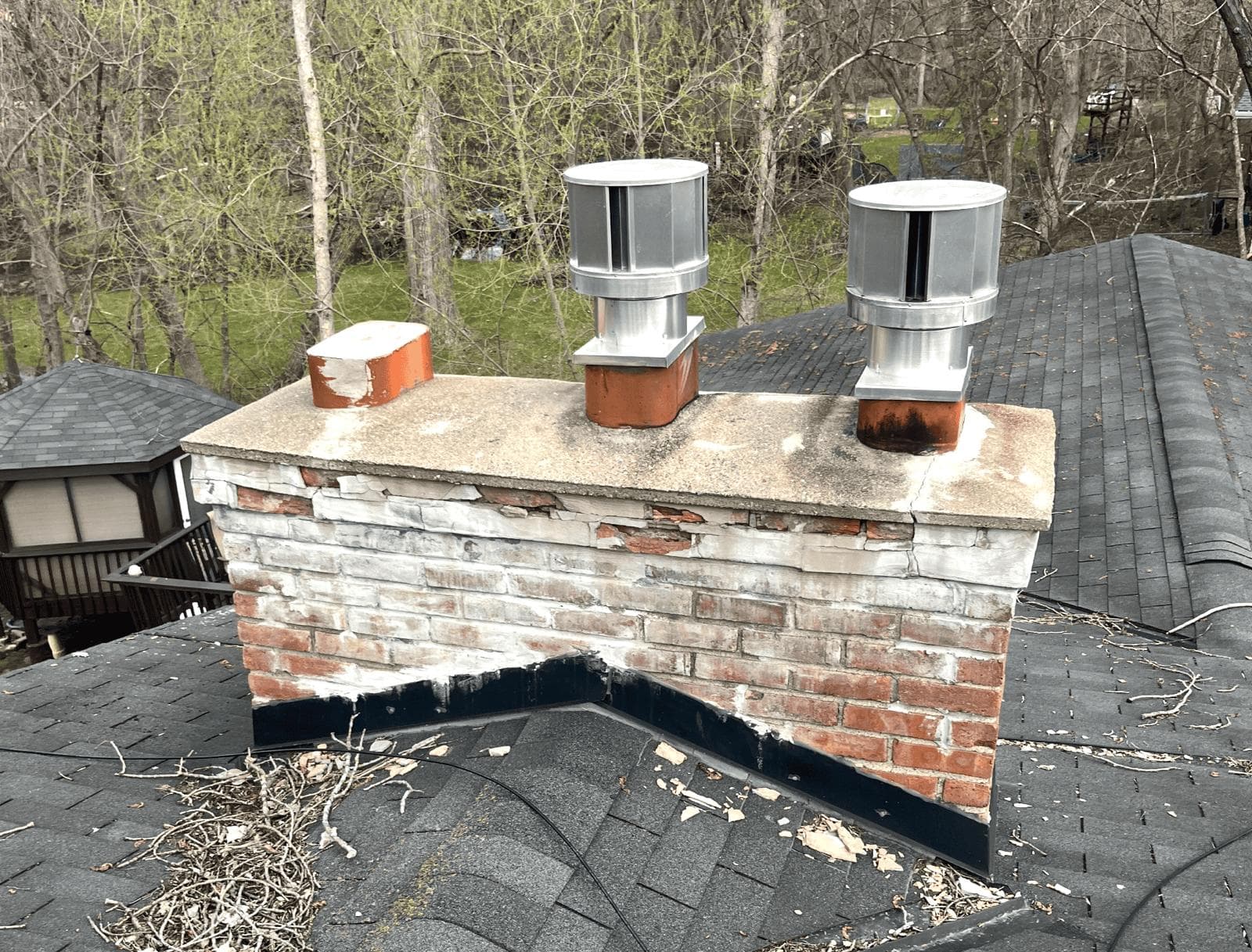
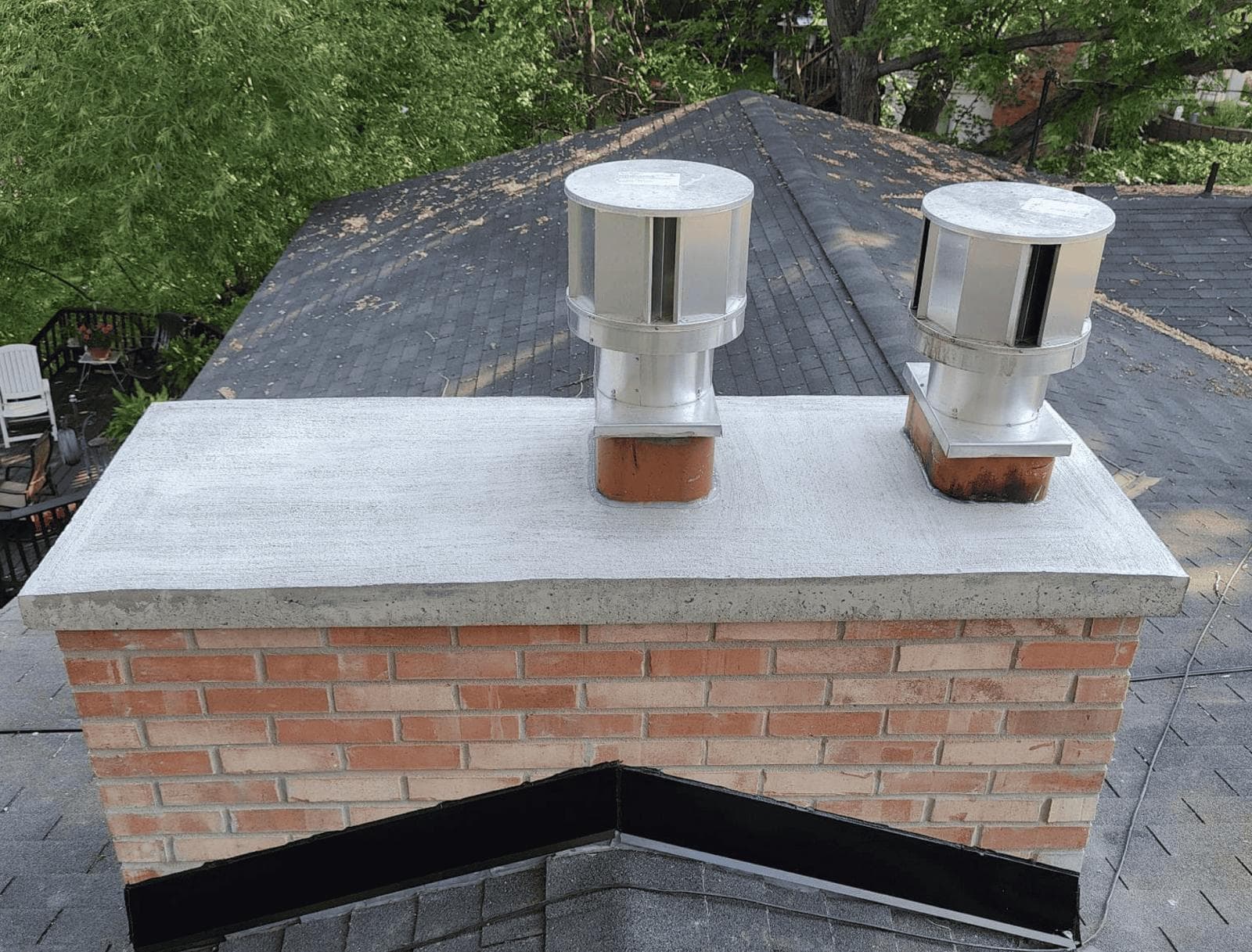
Chimney Masonry & Tuckpointing: our work
Real jobs we have done in the St. Louis metro.
Chimney Masonry & Tuckpointing: common questions
How much does chimney tuckpointing cost in St. Louis?
It varies too much to quote from a webpage — a small chimney needing partial repointing and a tall historic stack needing full repointing plus brick replacement are completely different jobs. We look at it, photograph it, and give you one fixed price in writing.
How long does tuckpointing last?
Properly ground out and repointed with correctly matched mortar, 25 to 30 years or more. Skim-coated over failing mortar, one to three seasons. The difference is entirely in the preparation.
Why does mortar matter so much on old St. Louis homes?
Homes built before roughly 1940 used soft lime mortar with soft, porous brick. That system is designed to flex and let moisture escape through the joints. Repointing with hard modern Portland-heavy mortar traps moisture and makes the mortar harder than the brick, so the brick face spalls off instead. On a historic St. Louis chimney, matching the original mortar is not a nicety — it decides whether the repair helps or actively causes damage.
What is the difference between tuckpointing and repointing?
In everyday usage in the trade they mean the same thing: removing failed mortar and replacing it. Strictly, tuckpointing is a historic decorative technique using two mortar colors. Everyone, including us, uses the terms interchangeably.
Can tuckpointing be done in winter?
Not reliably. Mortar needs temperatures consistently above about 40°F to cure properly, and it must not freeze while curing. In St. Louis that means roughly April through October is the safe window. Anyone offering to tuckpoint your chimney in January is setting up a repair that will fail.
Chimney Masonry & Tuckpointing across the St. Louis metro
We cover the full metro from University City. Chimney problems differ by neighborhood because the housing stock differs — here is what we see where.
Masonry in St. Louis
Predominantly 1890–1930 brick
Masonry in University City
Largely 1920s–1940s brick, Tudor and Colonial
Masonry in Clayton
1920s–1940s masonry, plus newer infill
Masonry in Kirkwood
Victorian through 1950s, wide mix
Masonry in Webster Groves
Victorian, Craftsman and 1920s bungalows
Masonry in Chesterfield
Mostly 1980s–2000s construction
Also serving Ladue, Ballwin, Creve Coeur, Maplewood, Brentwood, Florissant, St. Charles, Des Peres.
Related services
Chimney Repair
Chimney repair covers everything from a cracked crown or leaking flashing to a damaged flue liner. We start with a $69 inspection so you get photographs and one fixed price for exactly what your chimney needs — and the $69 comes off that price.
Chimney Rebuild
A chimney rebuild means taking the chimney down to sound masonry and rebuilding it. Most chimneys we are called out to look at need only the section above the roofline rebuilt, not the whole structure — and we will tell you that rather than sell you the bigger job.
Chimney Inspection
A full chimney inspection with Total Chimney Services costs $69 anywhere in the St. Louis metro, and the entire $69 is credited back to you if you book a repair with us.
Need chimney masonry & tuckpointing in St. Louis?
Start with a $69 inspection and a photo report. Credited back in full when you book the work. Call (314) 887-7250.
Open 24/7 · Emergency service, day or night.