Why Does My Chimney Only Leak When It Rains Hard?
If your St. Louis chimney only leaks during hard, wind-driven rain, the cause is almost always a small gap that light rain never finds and enough water hits it — a cracked crown, a lifted piece of flashing, or a mortar joint that's opened up. It is rarely a sign the whole chimney is failing, but it will get worse every time it happens.
Updated August 16, 2026
Why hard rain finds leaks that light rain doesn't
A drizzle falls straight down and mostly sheds off a sloped roof and a sound chimney crown without ever testing a small gap. Hard rain is different on two counts: there's simply more water hitting the same square foot of chimney per minute, and wind usually comes with it, which drives rain sideways and up under things that are only designed to shed water falling straight down.
That combination — volume plus wind-driven angle — is exactly what finds a hairline crack in a crown, a flashing seam that's lifted a quarter inch, or a mortar joint that's eroded just enough to let water track sideways into the brick. None of those gaps are dramatic. All of them are enough, once a storm pushes water at them from the wrong angle and in enough volume.
The three places water actually gets in
"The chimney is leaking" almost always means one of three specific things, and they're worth telling apart because the fix, the cost, and the urgency are different for each.
The crown is the concrete or mortar cap across the very top of the chimney. It's supposed to slope away from the flue and overhang the brick slightly so water drips clear of the masonry. A crown that has cracked, or one built flat with no overhang — common on chimneys built from the 1950s through the 1980s — lets water sit and soak straight down through the top.
Flashing is the metal strip where the chimney meets the roofline. It's stepped and layered specifically to shed water at that junction, and it fails by lifting, rusting through, or being sealed with roofing cement instead of properly re-flashed, which looks fine for a year or two and then cracks. A flashing leak often shows up as a stain on the ceiling near the chimney rather than inside the firebox itself.
The masonry — the brick and mortar of the chimney body — is the third path, and it's the one that shows up most in homes built before 1940 across St. Louis City, University City, Webster Groves and Maplewood. Those chimneys were built with soft lime mortar that was never meant to compete with modern Portland-cement mortar, and decades of freeze-thaw cycles (St. Louis runs through 40 to 50 of them a year) open the joints and spall the brick faces, giving water a path straight through the wall.
How to tell which one it is without getting on the roof
You don't need to climb up there, and we'd rather you didn't. A few things you can check safely from the ground or the attic tell us most of what we need to know before we ever come out.
Where the stain shows up matters. Water on the ceiling near where the chimney passes through the roofline points toward flashing. Water tracking down the inside of the firebox or damper area points toward the crown or the flue. Staining on an exterior wall below the roofline, especially on an older brick chimney, points toward the masonry itself.
Timing matters too. A leak that shows up in every rain, even light rain, is usually a bigger, more established gap. A leak that only shows up in wind-driven storms — the pattern this guide is about — is usually a smaller gap that's been getting slowly worse and will eventually leak in lighter rain too if it's left alone.
What you can't do from the ground is see hairline cracking in a crown, corrosion under a flashing seam, or mortar that's soft enough to fail but not yet visibly crumbled. That's what an inspection is actually for — not guessing from a picture, but getting eyes and a camera on the parts you can't see.
What happens if you leave it
A leak that only shows up in hard rain doesn't stay that way. Every cycle of water in, freeze, expand pushes the original gap a little wider, so a crack that only let water through during a wind-driven downpour this year is a crack that lets water through in ordinary rain next year.
Inside the chimney, water reaching the flue liner or the firebox can crack clay tiles, rust a metal liner, and — in the worst case — let combustion gases find their way into the house instead of up the flue. Outside, water sitting in masonry through a St. Louis winter is the single biggest cause of the spalling and crumbling brick faces we see on older chimneys across the metro. Both of those get meaningfully more expensive to fix the longer they run.
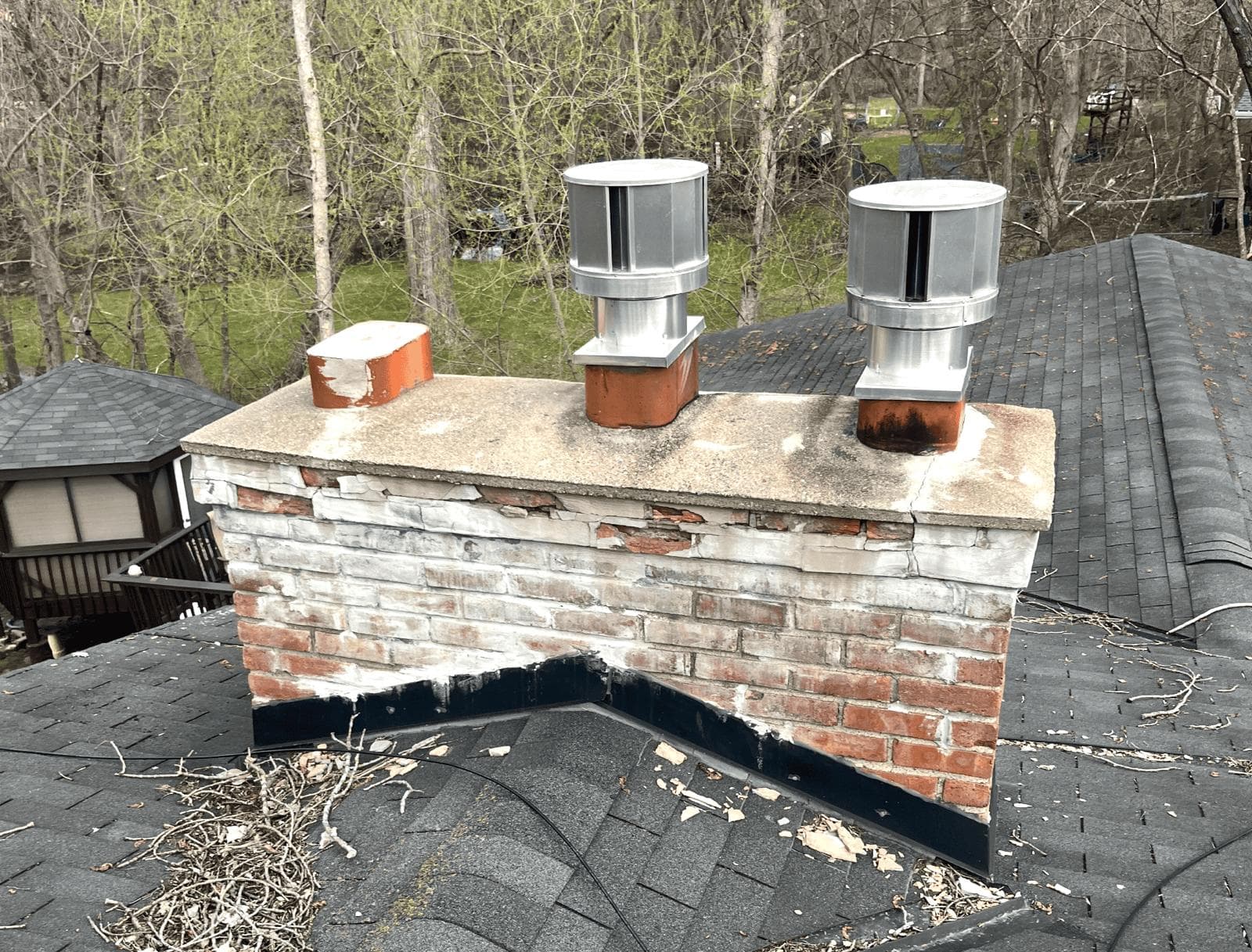
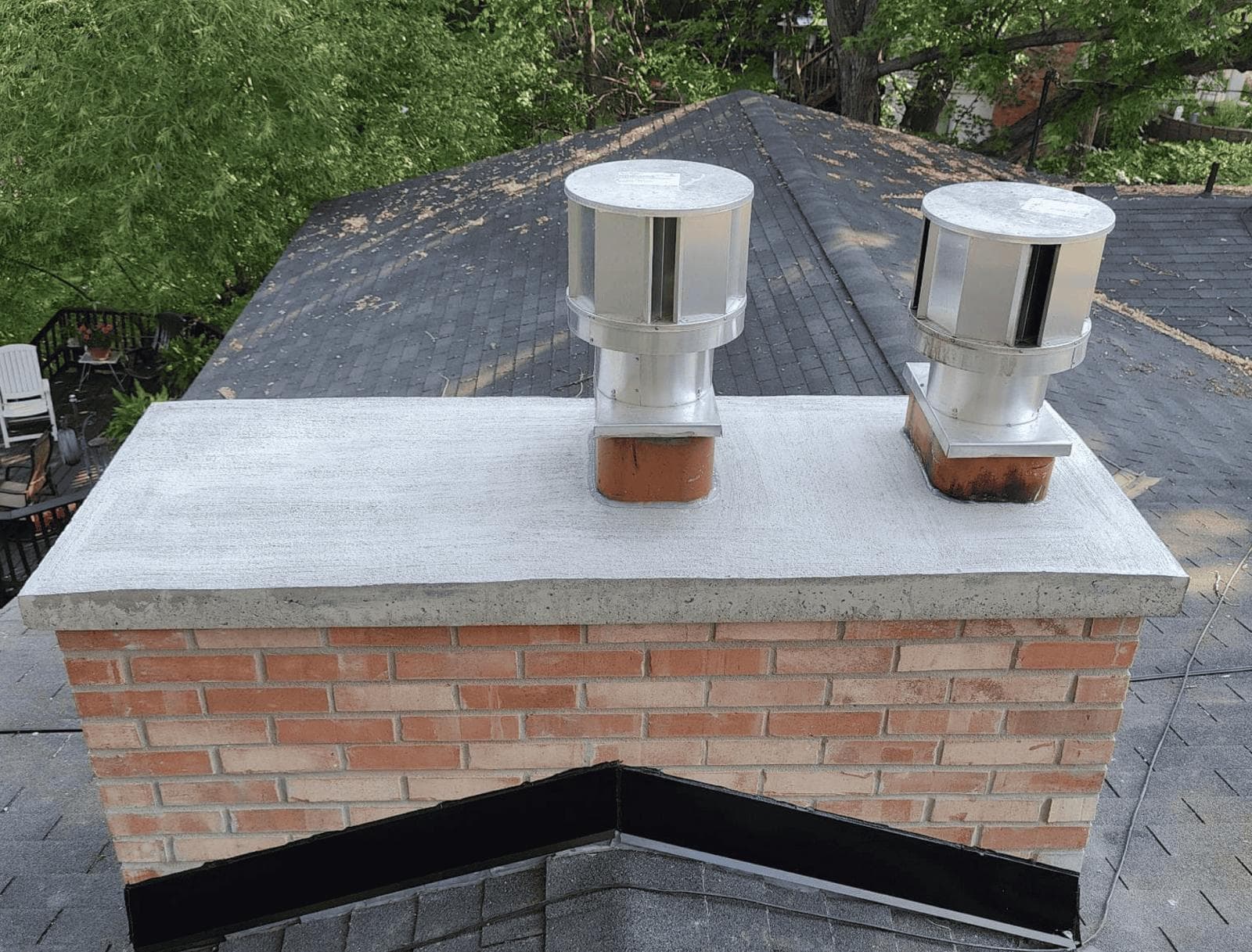
What this looks like on a real job
Photographs from our own work in the St. Louis metro.
Common questions
Does a chimney leak mean I need a new roof?
Almost never. A leak that's isolated to the chimney — staining that starts at or near the chimney rather than spread across the ceiling — is a chimney problem (crown, flashing, or masonry), not a roofing problem. Re-roofing without fixing the actual gap won't stop the leak.
Can I just caulk or seal the spot where I see water?
You can, and it will usually make the leak worse in the long run. Sealing over a symptom without knowing which of the three paths is actually letting water in traps moisture against the masonry instead of letting it dry, which accelerates the freeze-thaw damage that caused the leak in the first place.
How much water does it actually take to cause damage?
Very little, repeated often. A gap that lets in a cup of water during a hard storm is enough — once that water sits in mortar or wood framing through a freeze cycle, or reaches a flue liner, the damage isn't proportional to how much water you saw.
Is a chimney leak an emergency?
If you smell gas, see active water reaching a gas appliance connection, or notice smoke or soot entering the house, treat it as an emergency and call immediately — we answer 24/7. A leak that shows up only in hard rain and is not affecting a gas line or venting is not an emergency, but it should be looked at before the next big storm rather than after several more.
How do you find the leak if it only happens in a storm?
The stain pattern, the chimney's age and construction, and a close visual and photographic inspection of the crown, flashing, and masonry tell us where water is getting in without needing to catch it live during a storm. That's what the $69 inspection covers.
If this sounds like your chimney
A $69 inspection tells you exactly which of these it is, with photos, before anyone quotes a repair.
Chimney Leak Repair
Chimney leaks almost never enter where the water shows up. Water gets in at the crown, the flashing, the cap or through the masonry — then travels before it appears on your ceiling. The $69 inspection traces the actual source with photographs, and you get one fixed price to fix it.
Chimney Masonry & Tuckpointing
Tuckpointing is the process of grinding out failed mortar joints and packing in fresh mortar. Done properly, with mortar matched to the original, it buys a St. Louis chimney decades before the masonry needs attention again.
Chimney Inspection
A full chimney inspection with Total Chimney Services costs $69 anywhere in the St. Louis metro, and the entire $69 is credited back to you if you book a repair with us.
Not sure which one this is?
Start with a $69 inspection and a photo report. Credited back in full when you book the work. Call (314) 887-7250.
Open 24/7 · Emergency service, day or night.