What Gas Fireplace Brand Do I Have — and Who Services It?
We service every gas fireplace brand in the St. Louis metro, and for most repairs the brand matters far less than people expect. What actually decides the job is which ignition system the unit uses — a standing pilot that burns all season, or an electronic one that lights on demand — because the parts that fail, and the way they fail, are different. Your brand and model number are on a metal plate behind the lower louvre panel, and having them ready shortens the call considerably.
Updated September 24, 2026
Where the brand and model number actually are
Almost every gas fireplace carries a metal rating plate with the manufacturer, the model number and the serial number stamped on it. It is not on the front where you would look for it. It is behind the lower louvre panel — the vented grille below the glass — which usually lifts up and off, or pulls forward, without tools.
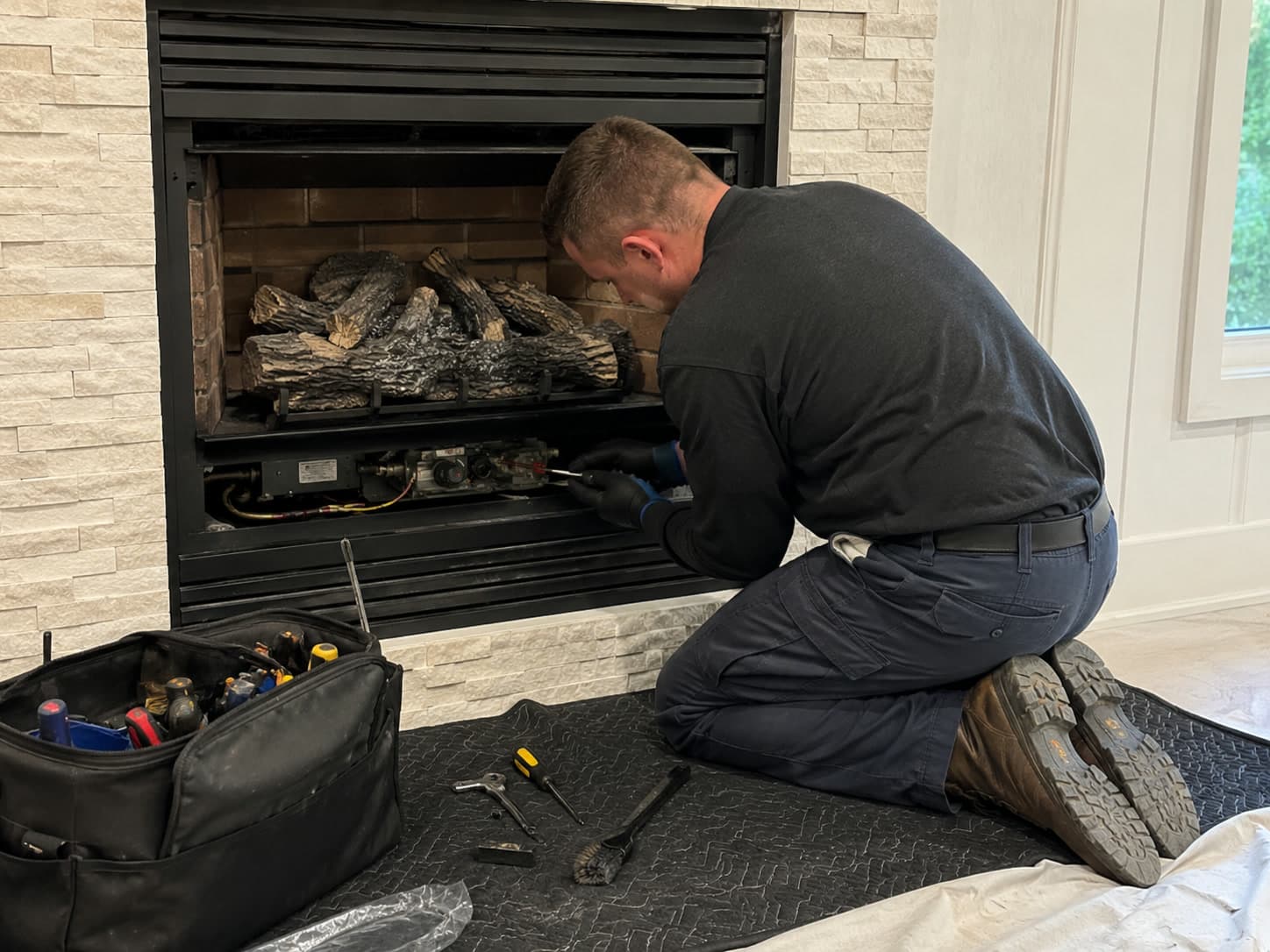
Behind that panel is the control compartment: the gas valve, the pilot assembly, the wiring, and the plate. That is the same compartment a technician opens first on any service call, which is why a photograph of that plate, taken on your phone, is the single most useful thing you can send before an appointment.
If the panel will not come away easily, do not force it. Some units have a screw or a clip retaining it, and a few have the plate mounted on the firebox wall instead. It is not worth breaking a louvre over — we will find it when we are there.
The brands that turn up in St. Louis homes
The names you are most likely to find on that plate in this market are Heatilator, Heat & Glo, Majestic, Superior, Empire Comfort Systems, Monessen, Napoleon and Kozy Heat. A great many of the factory-built fireplaces in 1980s-to-2000s St. Louis County construction carry one of the first four.
We service all of them. We also service the brands that are not on that list, including units whose manufacturer no longer exists — which is more common than people expect, because gas fireplace brands have consolidated heavily over the past thirty years and a name on a 1995 firebox may belong to a company that was absorbed twice since.
If you have searched for an authorised dealer for your brand and come up short, that is worth knowing: authorised dealer status is largely about selling new units and honouring factory warranties. Outside the warranty period, a competent gas technician services the appliance regardless of the badge, because the components inside are made by a small number of controls manufacturers and are broadly standard across brands.
The distinction that actually changes the repair
Gas fireplaces split into two families, and this matters far more than the brand.
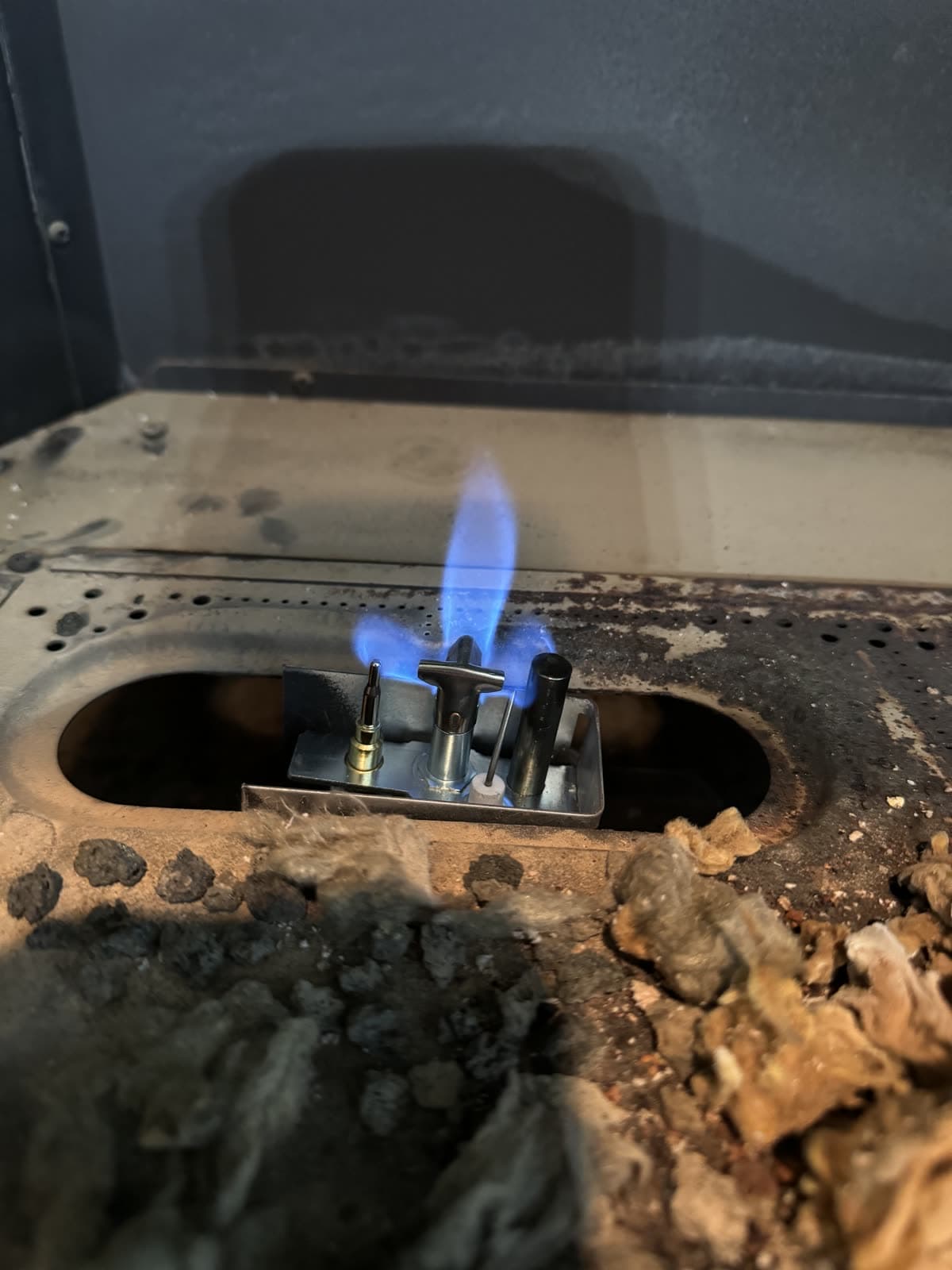
Standing pilot, also called millivolt. A small pilot flame burns continuously through the season. That flame heats a thermocouple and a thermopile, which generate the tiny amount of electricity that holds the gas valve open and lets the main burner fire. The whole system runs on the heat of its own pilot flame, which is why a standing-pilot fireplace still works in a power cut. You can tell you have one by opening the lower panel and looking for a small blue flame burning when the fireplace is off.
Electronic or intermittent pilot ignition, usually called IPI. There is no permanent flame. The pilot lights on demand when you press the remote or the wall switch, and a spark igniter does the lighting. These units need power — either mains, a battery backup, or both — and they do not work in a power cut unless the battery pack is good. You can tell you have one because there is no flame at all when the unit is off, and usually a battery compartment somewhere behind the panel.
Both are reliable. They simply fail differently, and the parts are not interchangeable between them. A homeowner who can say "there is a little flame burning all the time" on the phone has already told a technician half of what he needs to know.
What actually fails, on any brand
On standing-pilot units the usual suspects are the thermocouple and the thermopile — the two sensors that prove to the gas valve a flame is present. They are consumable parts. They weaken with age and with soot, and when they weaken the valve closes, which is the system doing exactly what it is designed to do rather than a fault in itself.
On electronic units the usual suspects are the igniter, the flame sensing rod, the control module and the battery pack. A unit that clicks repeatedly and never lights is telling you something quite specific, and it is not the same conversation as a pilot that will not stay lit.
Common to both: a pilot assembly fouled with dust and lint, a gas valve at the end of its life, a blower motor that has seized or grown loud, a cracked or fogged glass panel, and a failed gasket around that glass. On a direct-vent unit the glass is part of the sealed venting system, not a decorative front, so a gasket that has gone hard is a venting issue rather than a cosmetic one.
None of these are reasons to replace a fireplace. Parts availability is the real question on a unit past about twenty-five years, and that is a question the model number answers in a few minutes.
What to have ready when you call
Four things make the first call short and the visit accurate: the brand and model number from the plate, whether there is a pilot flame burning when the unit is off, what the fireplace does when you try to light it, and whether anything changed recently — a power cut, a battery replacement, a new remote, work done nearby.
If you cannot get to the plate, that is fine. Tell us what you can see and we will bring what the common systems need. The $69 inspection covers the diagnosis either way, and it comes off the repair if you book it with us.
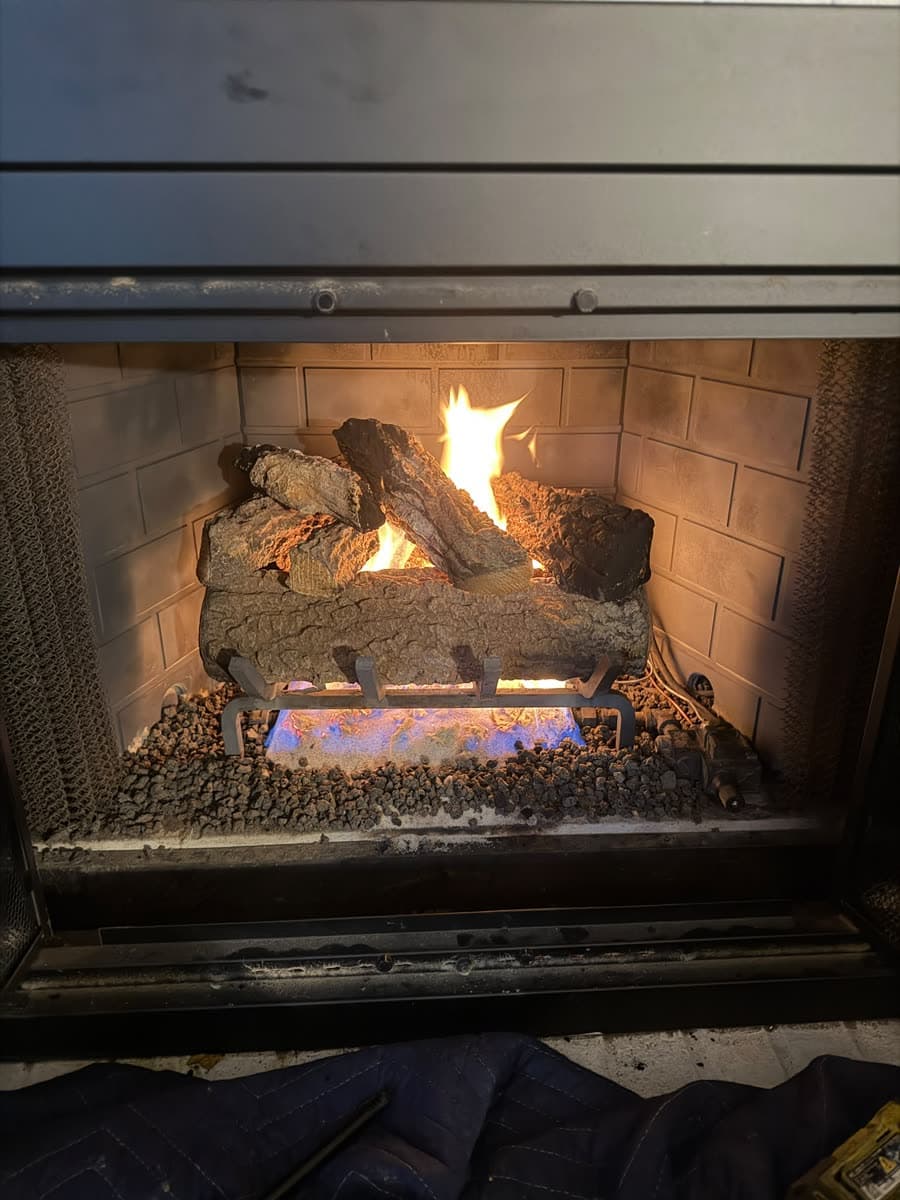
What this looks like on a real job
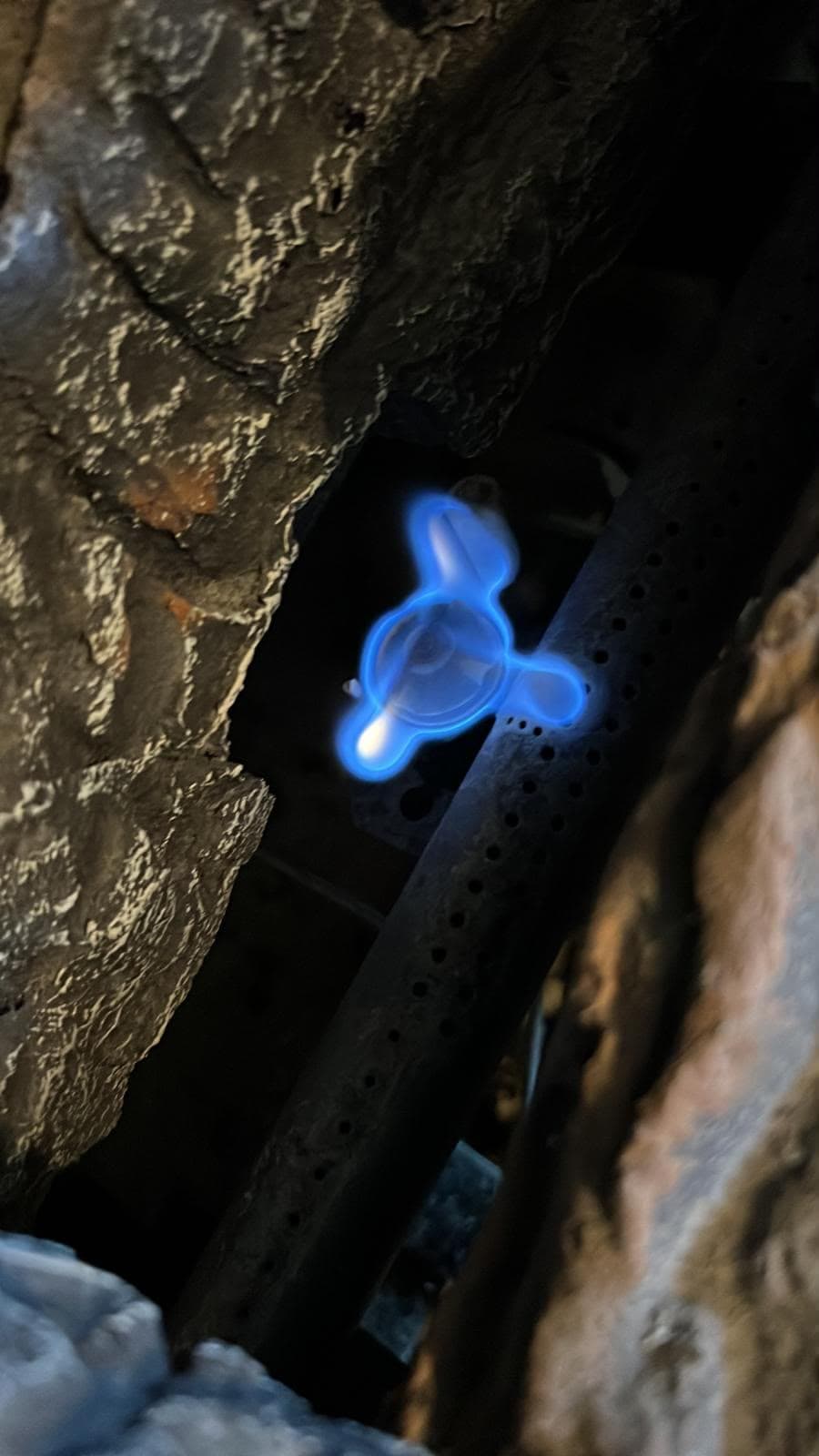
Photographs from our own work in the St. Louis metro.
Common questions
Do you service Heatilator, Heat & Glo, Superior, Majestic and Empire?
Yes, all of them, and every other gas fireplace brand in the St. Louis metro. Outside the factory warranty period the brand rarely changes the repair — the controls inside come from a small number of manufacturers and are broadly standard across badges.
Where do I find the model number on a gas fireplace?
On a metal rating plate behind the lower louvre panel, the vented grille below the glass. That panel usually lifts off or pulls forward without tools, and the plate is inside the control compartment alongside the gas valve. A phone photograph of it is the most useful thing you can send us before a visit.
Do I need the company that originally installed it?
No. Authorised dealer status mainly concerns selling new units and honouring factory warranties. Once a fireplace is out of warranty, any competent gas technician can service it, and a great many St. Louis installers are no longer trading anyway.
How do I know whether mine is a standing pilot or electronic ignition?
Open the lower panel and look while the fireplace is off. A small blue flame burning continuously means a standing pilot, also called millivolt — that unit will work in a power cut. No flame at all, and usually a battery compartment, means electronic or intermittent pilot ignition, which needs power to light.
My fireplace is twenty years old. Can it still be repaired?
Usually yes. The parts that fail most often — thermocouples, thermopiles, igniters, blowers — are still made and still available for most units of that age. Parts availability becomes a genuine question past roughly twenty-five years, and the model number settles it quickly.
The manufacturer of my fireplace does not exist any more. Now what?
That is common, because gas fireplace brands have consolidated heavily. In most cases the controls inside were made by a third party that is still trading, so the parts are still obtainable. We identify the components rather than the badge.
If this sounds like your chimney
A $69 inspection tells you exactly which of these it is, with photos, before anyone quotes a repair.
Gas Fireplace Repair
Most gas fireplace problems come down to a failed thermocouple or thermopile, a dirty pilot assembly, a bad igniter, or a blocked vent. We diagnose with instruments rather than replacing parts and hoping, then quote the repair before doing it.
Gas Fireplace Inspection
A gas fireplace inspection checks the venting, gas connections, burner combustion and safety controls, and includes a carbon monoxide reading with the unit running. Ours is $69, credited back in full if you book a repair.
Chimney Inspection
A full chimney inspection with Total Chimney Services costs $69 anywhere in the St. Louis metro, and the entire $69 is credited back to you if you book a repair with us.
Not sure which one this is?
Start with a $69 inspection and a photo report. Credited back in full when you book the work. Call (314) 887-7250.
Open 24/7 · Emergency service, day or night.