Does a Gas Fireplace Really Need Annual Service?
Yes, and for the opposite reason most St. Louis homeowners assume. A gas fireplace is not maintenance-free because it is clean — it needs checking precisely because it is clean. With a wood fire you can see soot and smell smoke when something goes wrong. A gas appliance venting badly gives you no warning at all, because carbon monoxide has no colour and no smell. Annual service is how that gets caught.
Updated September 6, 2026
The assumption that causes the problem
Almost everyone who has a gas fireplace installed is told it is low maintenance, and that is true as far as it goes. There is no wood to carry, no ash to shovel, no creosote building up in the flue. Compared with an open fire it genuinely is less work.
The trouble is the leap from low maintenance to no maintenance. A gas fireplace is a gas appliance with a sealed combustion chamber, a vent, an igniter, safety sensors and a set of moving parts, running at high temperature for months at a time. Nobody would run a furnace for ten years without a service. The fireplace is the same category of machine, and it sits in the room people spend their evenings in.
The clean burn is exactly what hides the wear. There is no soot pile to make you think about it and no smoke to remind you it is a combustion appliance. It keeps looking fine right up until the moment it does not work, or the moment something is quietly wrong with how it is venting.
What actually wears out
The parts that fail are small, cheap and predictable, which is the good news. Caught early they are a routine repair; ignored, they are the reason the fireplace does not light on the first genuinely cold night of the year.
The thermocouple or thermopile is the sensor that proves to the gas valve that a flame is really burning. It degrades gradually with heat cycling, and as it weakens the pilot starts going out more often — first occasionally, then most times. This is by far the most common reason a gas fireplace stops working.
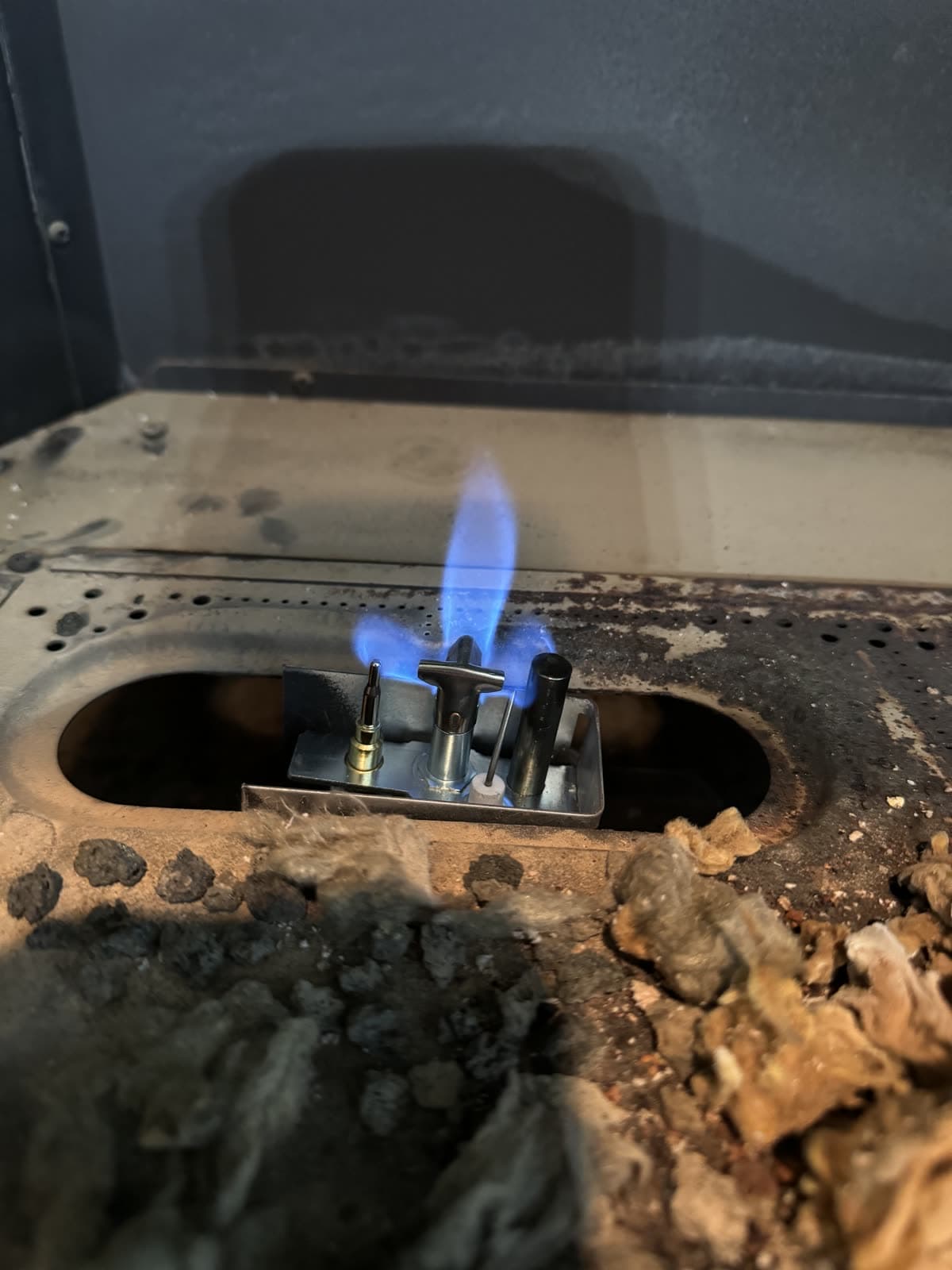
The pilot assembly and burner ports collect dust, pet hair and spider webbing over a summer of sitting idle. A partially blocked port changes the shape of the flame, and a flame in the wrong place is not sensed reliably and does not burn cleanly.
The glass gasket, the seal around the fixed glass front on a direct-vent unit, hardens and shrinks with age. On a sealed system that gasket is part of how the unit vents correctly, so a failed one is not a cosmetic issue.
The vent itself and its termination outside can be blocked by a bird nest, a wasp nest, or debris blown in over the summer. This is the failure that matters most, and it is the one nobody can see from inside the room.
The failure with no warning sign
Everything above announces itself eventually. A weak thermocouple makes the pilot drop out. A dirty burner makes the flame look wrong. You notice, you get annoyed, you call someone.
Bad venting does not do that. If exhaust is not leaving properly it comes back into the room, and the main product of incomplete combustion is carbon monoxide — no colour, no smell, no taste. The early symptoms are headaches, nausea and drowsiness, which in December read as a cold or a long day rather than as a fireplace problem.
There are things worth noticing: soot on the glass, on the logs, or on the wall above the fireplace; condensation on the glass; a flame that burns yellow or orange where it used to be blue; an unusual smell when it runs. Any of those means get it looked at now, not at the end of the season.
But the reason annual service exists is that venting can be wrong while none of those signs are present. A carbon monoxide reading taken with the unit actually running is the only way to know, and it is not something to judge by eye.
Why the timing matters in St. Louis specifically
A gas fireplace here sits unused from roughly March to November. Eight or nine months of a humid Missouri summer is long enough for dust to settle on the burner, for a wasp or bird to take an interest in the vent termination, and for a marginal sensor to go from just-working to not-working while nobody is watching.
Then everyone lights it on the same cold weekend. That is why the first real cold snap generates a wave of calls, and why booking in September or October rather than December is worth doing — not because the work is different, but because the wait is.
There is a second reason specific to this metro. A large share of housing built after 1985 has a factory-built fireplace — a metal firebox and chimney inside a framed and sided chase rather than solid masonry. Those systems have a real service life of roughly 20 to 30 years, and a great many of them across Chesterfield and the newer St. Charles County subdivisions are reaching it now. On those units the chase cover, the flat metal lid on top of the chase, usually fails first and lets water into the chase around the vent.
What a service actually covers
It is not a clean and a look. The vent run gets checked for blockage, correct pitch and proper sealing, and the termination outside gets inspected. The gas connections and pressure get tested. The thermocouple, thermopile, igniter and gas valve get measured with a meter rather than assessed by eye. The burner and pilot assembly get cleaned. The glass and gasket get checked. And a carbon monoxide reading is taken with the unit running.
Ours is a flat 69 dollars anywhere in the metro, with no trip charge, and it comes with a written report and photographs. If anything needs repairing you get one fixed price in writing before any work starts, and the 69 dollars comes off it in full.
One thing worth being direct about: this is not DIY territory, and not because of the price. Testing a thermocouple properly needs a meter, checking a vent means getting to the termination, and a carbon monoxide reading needs an instrument taken with the appliance running. Guessing at any of those on a gas appliance is not worth the saving.
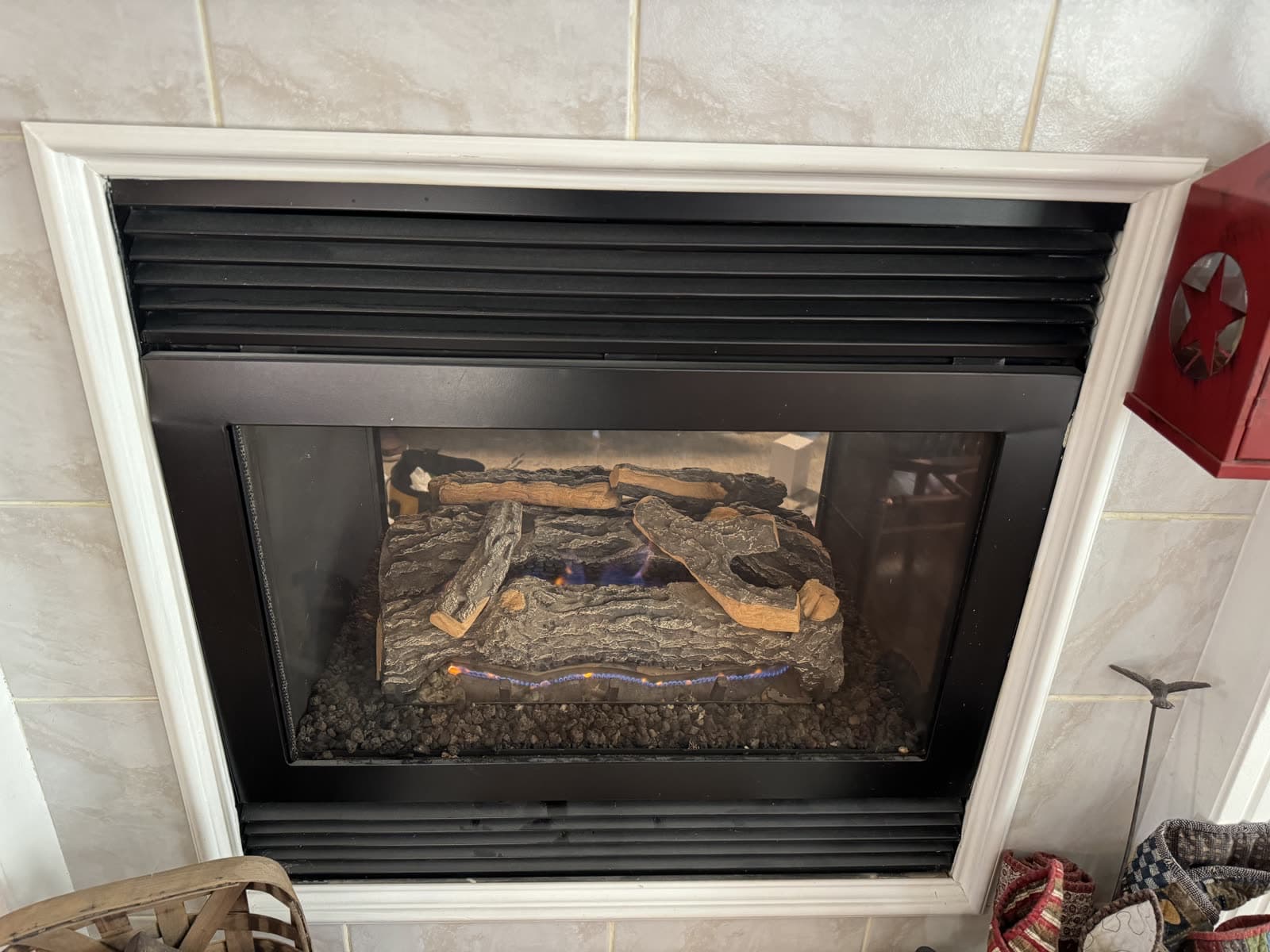
What this looks like on a real job
Photographs from our own work in the St. Louis metro.
Common questions
How often does a gas fireplace actually need servicing?
Once a year, before the heating season, is the standard for a unit in regular use. If it is only lit a handful of times a winter you can reasonably stretch it, but do not skip it entirely — the vent blockage risk is the same whether the fireplace is used weekly or twice a year.
We only use it a few times a winter. Does that change anything?
Less than people expect. Wear on the sensors tracks running hours, so light use does slow that down. But dust settling on the burner, a nest in the vent termination and a hardening glass gasket all happen on a calendar, not on usage. A rarely-used fireplace can be in worse shape than a well-used one.
The fireplace works fine. Is there really anything to check?
Working and venting correctly are two different things. A unit can light instantly, look normal and still not be clearing exhaust properly. That is the specific gap annual service exists to close, and it is why the carbon monoxide reading is taken with the unit running rather than judged by appearance.
Does a gas fireplace chimney need sweeping like a wood one?
Not in the same way — there is no creosote, so there is nothing to sweep out. What the vent does need is an inspection for blockage, corrosion and correct sealing. Different job, same appointment.
What are the signs I should not wait for the annual service?
Soot on the glass, logs or wall above the fireplace; condensation on the glass; a flame burning yellow or orange instead of blue; a pilot that keeps going out; any unusual smell when it runs; or anyone in the house getting headaches or feeling drowsy while it is on. Any of those means book now.
When is the best time to book?
September or October. The work is identical in December, but so is everyone else's timing — the first genuine cold snap produces a wave of calls, and that is when waits get long. Booking before the season starts is about availability, not about the job.
If this sounds like your chimney
A $69 inspection tells you exactly which of these it is, with photos, before anyone quotes a repair.
Gas Fireplace Inspection
A gas fireplace inspection checks the venting, gas connections, burner combustion and safety controls, and includes a carbon monoxide reading with the unit running. Ours is $69, credited back in full if you book a repair.
Gas Fireplace Repair
Most gas fireplace problems come down to a failed thermocouple or thermopile, a dirty pilot assembly, a bad igniter, or a blocked vent. We diagnose with instruments rather than replacing parts and hoping, then quote the repair before doing it.
Chimney Cap Installation
A chimney cap is a metal cover with mesh sides that sits on top of the flue. It keeps out rain, animals and debris, and stops burning embers from landing on your roof. It is the cheapest part of a chimney and it prevents the most expensive problems.
Not sure which one this is?
Start with a $69 inspection and a photo report. Credited back in full when you book the work. Call (314) 887-7250.
Open 24/7 · Emergency service, day or night.